How Much Time (and Money) Do Accountants Lose Chasing Clients? (Australia, 2026)
Australian survey data on how much chasing clients for documents, payments, and sign-offs actually costs accounting firms each year, and what firms are doing about it.
This guide is written for Australian accounting and bookkeeping firm owners and managers wanting to quantify the cost of manual client follow-up. It explains how the obligation fits into Australian public practice, how firms can plan lodgement deadlines before they become urgent, and how client reminders, workflow ownership and practice management routines can reduce compliance risk.
Key dates and timing considerations
Due dates are only useful when the firm turns them into a working system. Australian accounting firms need to know the statutory or ATO lodgement deadline, but they also need earlier internal workflow dates for record collection, preparation, manager review, partner review, client approval and final lodgement.
- Unrecovered out-of-scope work and unbilled chasing costs the average Australian accounting practice more than $100,000 a year, roughly $8,650 a month.
- 95% of accountants and bookkeepers say chasing clients for late payments or unbilled work is one of the most awkward situations they face, on average once a week.
- 78% said chasing late payments specifically was the conversation they were most reluctant to have with a client.
- 91% of Australian accountants said they'd save at least one hour a day if their firm's software systems were properly integrated; 33% said they'd save more than seven hours a week.
How to operationalise this inside an accounting firm
The most effective firms treat this topic as part of a wider compliance operating rhythm, not as an isolated date in a diary. A partner, director or manager should be able to open one view and see which clients are affected, which due dates are coming up, which reminders have been sent, which work is waiting on the client and which lodgements are at risk. That visibility is what turns a tax calendar into a practice management tool.
For public practice teams, the first step is to define ownership. Every client should have a responsible manager or staff member, and every recurring obligation should have a clear workflow path. That path normally includes information requested, information received, preparation started, manager review, partner review, client approval and lodged. Smaller firms may use fewer stages, but the principle is the same: the firm needs a shared language for progress.
Client communication
Client reminders should be specific, early and consistent. A useful reminder explains what the firm needs, when it is needed, what the client should do next and why the timing matters for ATO compliance or the relevant lodgement deadline.
Manager visibility
Managers need more than a list of dates. They need to know which clients have not responded, which jobs are unassigned, which obligations are approaching review and where workflow capacity is becoming tight across the team.
This is especially important when a firm is moving away from a spreadsheet. Spreadsheets can record due dates, but they rarely create reliable accountability. They do not automatically show whether a client reminder was sent, whether a manager changed, whether an email bounced, or whether a lodgement is still waiting for approval. A structured compliance workflow gives the team a better way to manage recurring deadlines without relying on memory or inbox archaeology.
The cost, in Australian numbers
Every accountant knows the feeling: you've sent the email, followed up twice, and you're still waiting on a document, a signature, or a payment before you can move a job forward. It feels like a minor annoyance in the moment. The data says otherwise, for Australian firms, chasing clients is a genuine, measurable drag on profitability and wellbeing.
A national survey of 557 Australian accounting and bookkeeping decision-makers, conducted by YouGov on behalf of Ignition, put real figures on this problem. Unrecovered out-of-scope work and unbilled chasing costs the average Australian accounting practice more than $100,000 a year, roughly $8,650 a month.
95% of accountants and bookkeepers said chasing clients for late payments or unbilled work is one of the most awkward situations they face, on average once a week. 78% said chasing late payments specifically was the conversation they were most reluctant to have with a client.
The knock-on effects were significant: 41% of firms reported lost income, 36% reported a decline in work quality, 31% reported cash flow pressure, and 23% said profitability issues had forced them to shut down part of the business.
It's not just chasing payments, it's chasing everything
A separate 2024 survey of 422 Australian accountants by The Access Group found the broader administrative burden is getting worse, not better. 68% of respondents said being an accountant is "harder now than ever before", only 9% said it's gotten easier.
91% said they'd save at least one hour a day if their firm's software systems were properly integrated. 33% said they'd save more than seven hours a week, nearly a full working day.
Put together, these two surveys describe the same underlying problem from two angles: disconnected systems and manual follow-up create a constant low-grade chase, for documents, for signatures, for payment, that firms are absorbing as unpaid overhead rather than billable, valuable work.
Why this keeps happening
The root cause isn't client goodwill, it's visibility. Firms relying on spreadsheets, shared inboxes, or a practice manager's memory to track hundreds of obligations across hundreds of clients have no reliable way to know what's overdue until someone manually checks. That means follow-ups happen late, inconsistently, or not at all until a deadline is imminent, at which point the "awkward conversation" becomes urgent rather than routine.
Firms that have moved this tracking into a system, where every entity has its own compliance record and reminders fire automatically rather than depending on someone remembering to chase, report far fewer of these last-minute scrambles, because the follow-up happens before the awkward conversation is even needed.
What this means for your firm
If your team is spending hours a week manually tracking who owes what and following up by memory, the Ignition and Access Group numbers suggest that's not a personal productivity gap, it's an industry-wide structural problem, and it's costing the average firm well into six figures a year in absorbed time and lost income.
This is exactly the gap TaxCalendar is built to close: every client entity, company, trust, SMSF, individual, has a permanent compliance record with obligations and reminders tracked automatically, so client follow-ups happen on schedule without a partner or admin having to remember to chase.
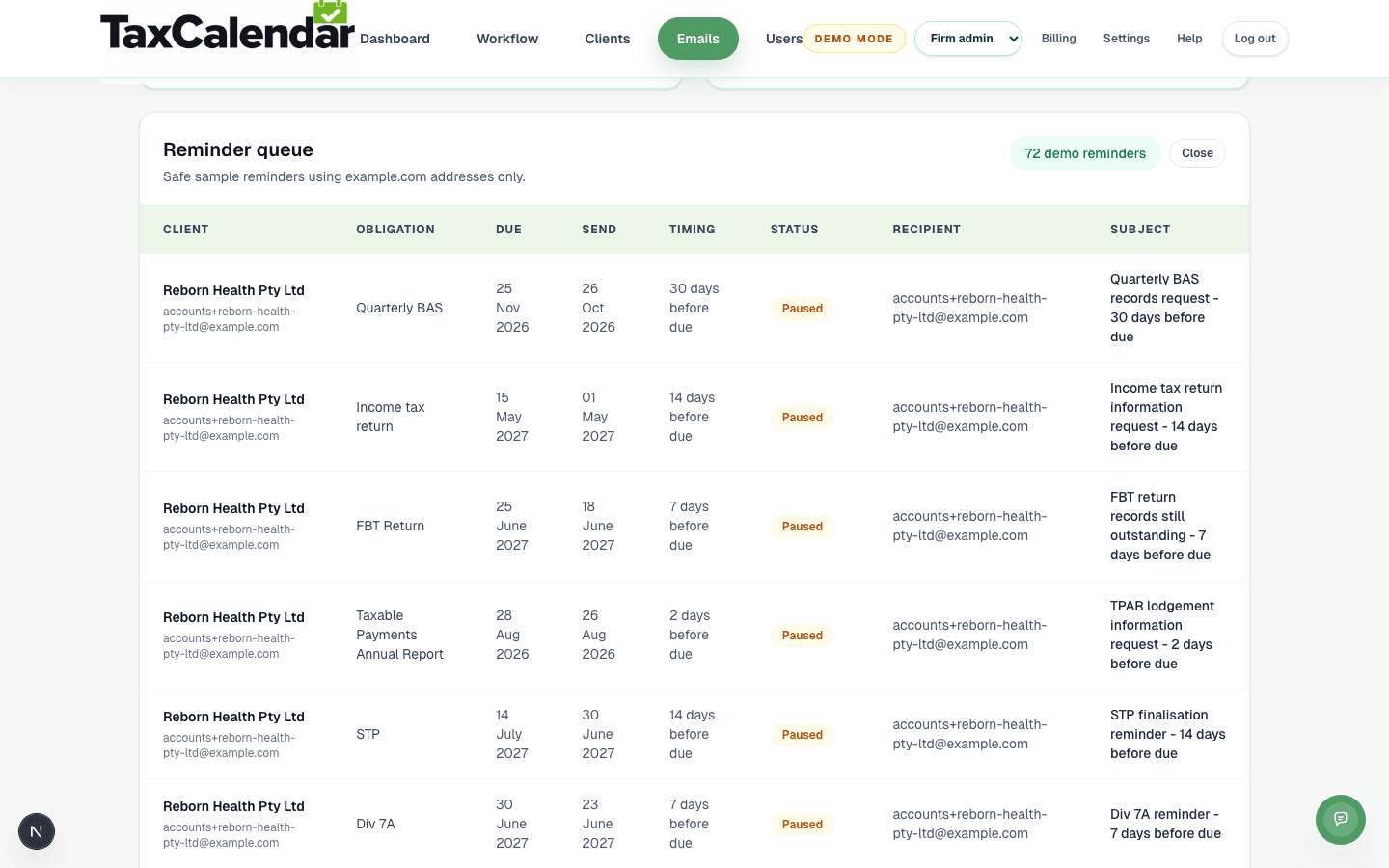
Automatic follow-up
TaxCalendar's reminder queue tracks every outstanding client obligation and fires follow-ups on schedule, so chasing stops depending on someone remembering to do it.
Recommended reminder and workflow cadence
A strong compliance process separates client communication from internal work allocation. Tax agents can use client reminders at 30, 14, 7, 2 and 0 days before the due date, while managers use earlier workflow dates to check whether records have arrived, preparation has started and review is on track.
This matters because lodgement deadlines are rarely missed for one dramatic reason. They are missed because small items stay hidden: a missing email address, an unassigned manager, a client who has not approved the work, or an obligation sitting in a spreadsheet that only one person trusts. TaxCalendar is built to make those issues visible before they become deadline pressure.
Where TaxCalendar fits
TaxCalendar helps Australian accounting firms turn compliance dates into a visible workflow. Firms can track clients, obligations, due dates, manager ownership, reminder status and lodged status in one place. That gives public practice teams a practical operating layer for BAS, IAS, ATO lodgement calendars, annual returns, client reminders and recurring practice management routines.
Related questions
How much does chasing clients cost Australian accounting firms?
A YouGov survey of 557 Australian accounting and bookkeeping decision-makers found unrecovered out-of-scope work and unbilled chasing costs the average practice more than $100,000 a year, roughly $8,650 a month.
How often do accountants have to chase clients for payment or documents?
95% of accountants and bookkeepers surveyed said chasing clients for late payments or unbilled work is one of the most awkward situations they face, happening on average once a week.
Would better software integration save accounting firms time?
Yes. 91% of Australian accountants surveyed said they'd save at least one hour a day with properly integrated systems, and a third said they'd save more than seven hours a week.
Why do firms keep chasing the same clients every cycle?
Usually because of visibility, not client goodwill. Without a system tracking every obligation and firing reminders automatically, firms only find out something is overdue when someone manually checks, so follow-up happens late or not at all.
How can firms reduce time spent chasing clients?
By moving obligation tracking and client follow-up out of spreadsheets and memory and into a system where every entity has a compliance record and reminders fire automatically ahead of the deadline.
Sources
Facts and figures in this guide are drawn from the following official sources. Rates and thresholds are indexed periodically, so always confirm current amounts before quoting them to a client.