How Much Are Missed Deadlines Costing You? The Real Cost of Late ATO and ASIC Lodgements
Quantifying what a missed ATO or ASIC deadline actually costs an accounting firm: penalties, interest, late fees and the staff time spent chasing, explaining and preparing remission requests.
This guide is written for Accounting firm partners and managers wanting to understand the full cost of late lodgements, including staff time. It explains how the obligation fits into Australian public practice, how firms can plan lodgement deadlines before they become urgent, and how client reminders, workflow ownership and practice management routines can reduce compliance risk.
Key dates and timing considerations
Due dates are only useful when the firm turns them into a working system. Australian accounting firms need to know the statutory or ATO lodgement deadline, but they also need earlier internal workflow dates for record collection, preparation, manager review, partner review, client approval and final lodgement.
- The ATO's failure to lodge (FTL) penalty is calculated at one penalty unit for every 28 days, or part thereof, that a lodgement is overdue, up to a maximum of five penalty units. Penalty unit values are indexed periodically, so always confirm the current amount on ato.gov.au before quoting a figure to a client.
- General interest charge (GIC) accrues daily on any unpaid tax debt on top of the penalty itself, at a rate that resets every quarter and has generally sat above 10% per annum.
- ASIC's late fee for a company annual review is charged in two tiers, a lower amount for payment up to one month late and a substantially higher amount for payment more than one month late, on top of the annual review fee itself.
- None of the above includes the firm's own time: chasing the client beforehand, explaining the penalty notice afterwards, and preparing and lodging a remission request.
How to operationalise this inside an accounting firm
The most effective firms treat this topic as part of a wider compliance operating rhythm, not as an isolated date in a diary. A partner, director or manager should be able to open one view and see which clients are affected, which due dates are coming up, which reminders have been sent, which work is waiting on the client and which lodgements are at risk. That visibility is what turns a tax calendar into a practice management tool.
For public practice teams, the first step is to define ownership. Every client should have a responsible manager or staff member, and every recurring obligation should have a clear workflow path. That path normally includes information requested, information received, preparation started, manager review, partner review, client approval and lodged. Smaller firms may use fewer stages, but the principle is the same: the firm needs a shared language for progress.
Client communication
Client reminders should be specific, early and consistent. A useful reminder explains what the firm needs, when it is needed, what the client should do next and why the timing matters for ATO compliance or the relevant lodgement deadline.
Manager visibility
Managers need more than a list of dates. They need to know which clients have not responded, which jobs are unassigned, which obligations are approaching review and where workflow capacity is becoming tight across the team.
This is especially important when a firm is moving away from a spreadsheet. Spreadsheets can record due dates, but they rarely create reliable accountability. They do not automatically show whether a client reminder was sent, whether a manager changed, whether an email bounced, or whether a lodgement is still waiting for approval. A structured compliance workflow gives the team a better way to manage recurring deadlines without relying on memory or inbox archaeology.
What a missed ATO deadline costs in penalties and interest
The failure to lodge (FTL) penalty applies to the lodgement itself, not the tax payable, so a nil or refund BAS lodged late can still attract a penalty. The base rate is one penalty unit per 28-day block the lodgement is overdue, capped at five blocks. Small entities are charged at that base rate, medium entities at twice the rate, and large entities at five times the rate, so the same lateness costs very different amounts depending on the client's turnover.
Take a BAS lodged 50 days late for a small business. That rounds up to two 28-day blocks, so two penalty units apply. If the client also owes tax, general interest charge accrues daily on the unpaid amount from the original due date, compounding on top of the FTL penalty rather than replacing it. A client can end up owing the penalty, GIC on the tax debt, and the tax itself, all from a lodgement that was only a few weeks late.
For a public practice, the operational risk is rarely the date itself. The risk is that no-one owns the follow-up, the client reminder is sent too late, the manager cannot see what is stuck, or the team is using a spreadsheet that is no longer trusted. TaxCalendar is designed to connect due dates, client reminders, workflow ownership and compliance visibility in one place.
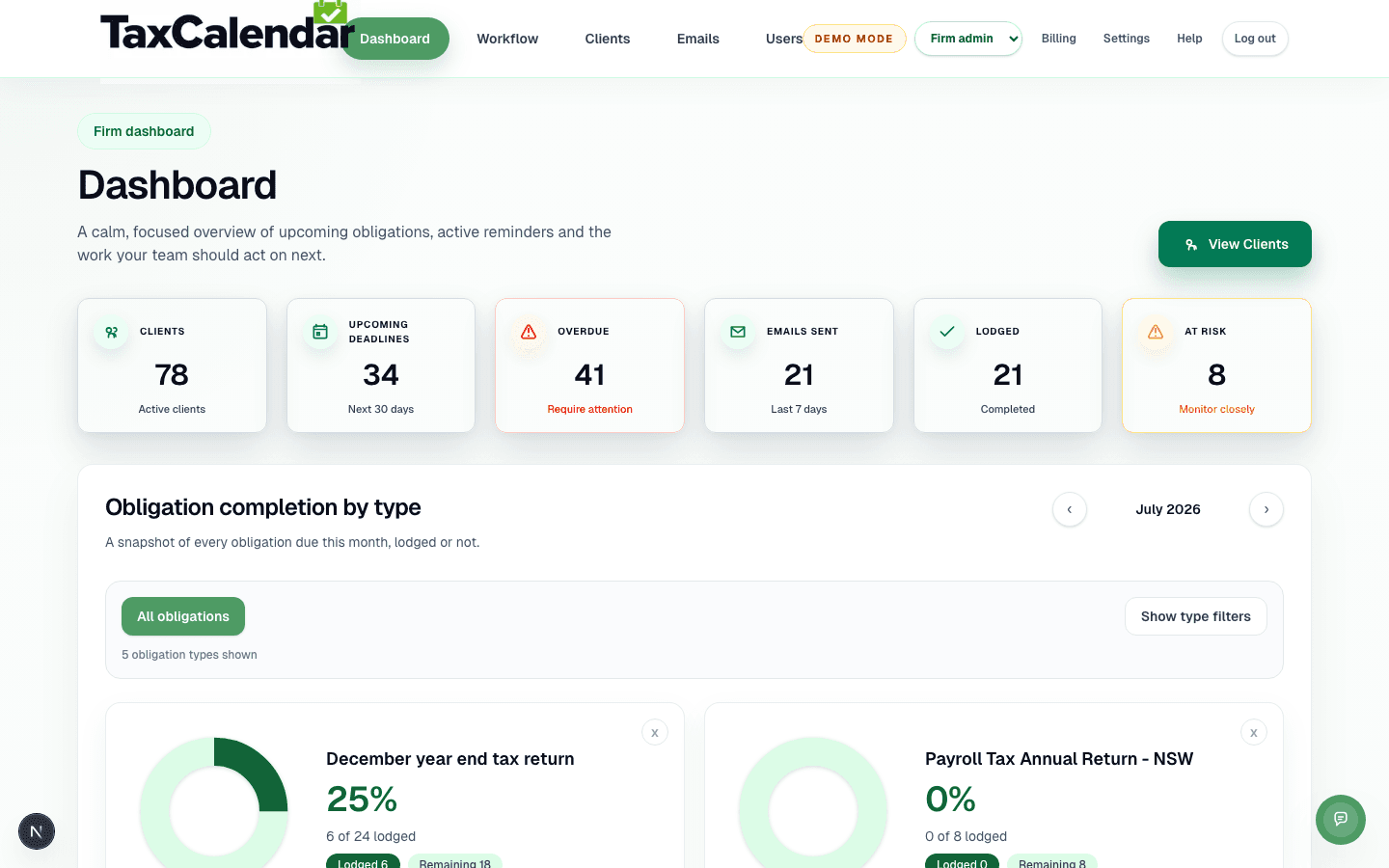
Overdue obligations dashboard
TaxCalendar's dashboard surfacing overdue and at-risk obligations before they turn into a penalty notice, rather than after.
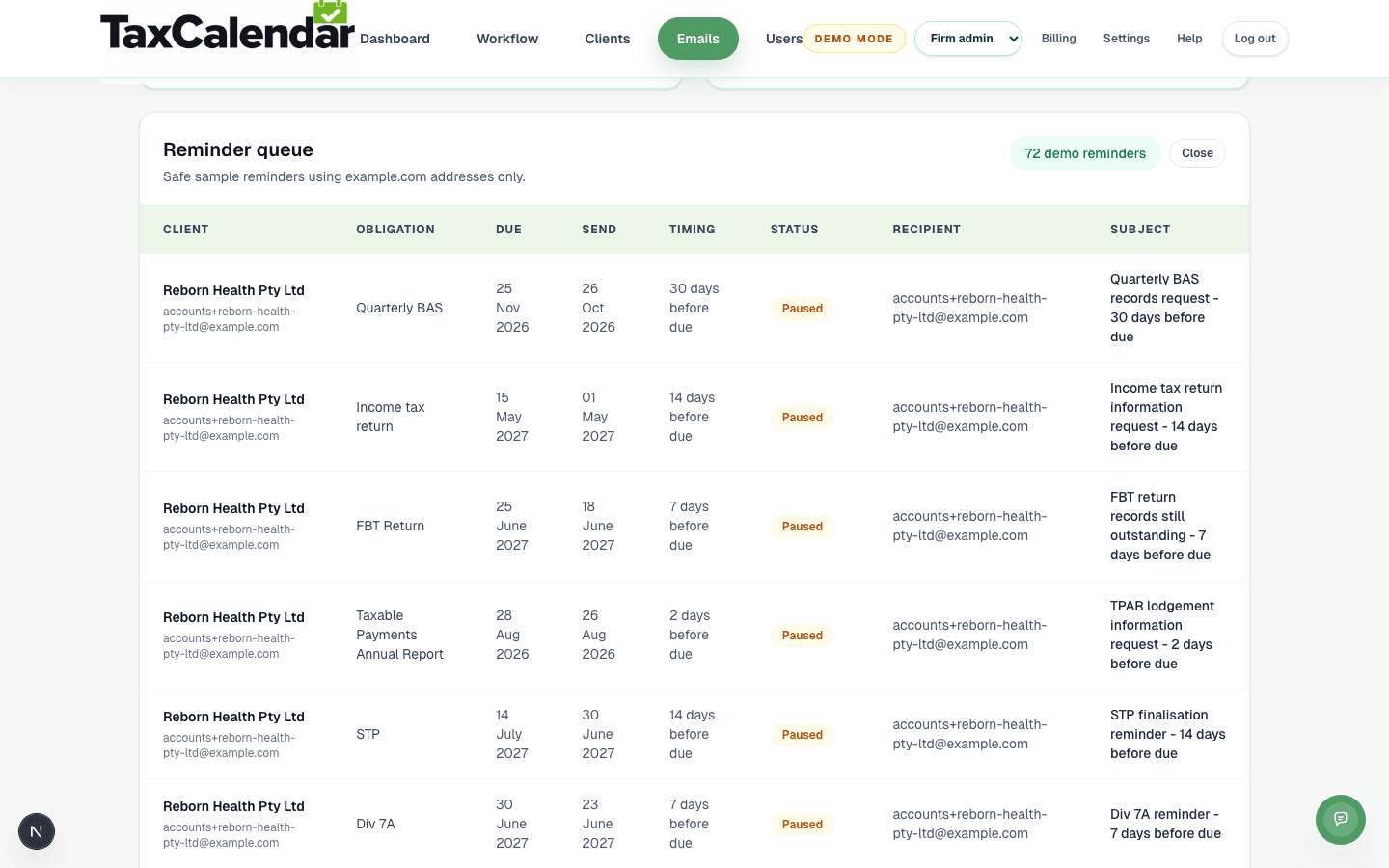
Staged reminder queue
A staged reminder scheduled ahead of the due date, aimed at reducing how often a lodgement becomes late in the first place.
What a missed ASIC deadline costs
ASIC charges a company annual review fee every year, and if it isn't paid on time, a late fee applies on top of it, in two tiers depending on how late payment is. The late fee for the more overdue tier is meaningfully larger than the annual review fee itself, so a company that misses the payment window can end up paying more in late fees than the underlying compliance cost. If a company's annual review fees remain unpaid for an extended period, ASIC can also move to deregister it, which creates a much larger problem than the original late fee.
Firms managing both ATO and ASIC obligations for the same client, which is most firms with corporate clients, can see both cost layers stack for a single business in the same period: an ATO penalty on a late BAS or tax return, and an ASIC late fee on the annual review, arriving in the same few months.
The cost most firms don't put a number on: staff time
Penalties and late fees are the visible cost. The less visible cost is everything the firm does around a late lodgement, and it happens whether or not the client is ever billed for it. Before the due date, it's the repeated follow-up: firms commonly need three or four follow-ups across emails and calls before a client sends through what's needed, and the same clients tend to repeat that pattern every cycle.
After a lodgement runs late, the cost shifts into explaining and fixing it. A manager has to explain the penalty notice to a client who often doesn't understand why they've been charged, especially when no tax was owed. If the circumstances justify it, the firm then prepares a remission request: setting out what happened, gathering evidence, lodging it with the ATO or ASIC, following it up, and reporting the outcome back to the client. None of that is quick, and very little of it is separately billed.
As a rough guide, if a manager spends 45 minutes on the explaining-and-remission-request cycle for a single client, at a fully loaded staff cost in the order of $80 to $120 an hour, that's $60 to $90 of largely unbillable time for that one lodgement, before counting the earlier chasing that contributed to it running late. A firm managing a few hundred clients across quarterly BAS, IAS and annual ASIC obligations doesn't need many of these a quarter for it to add up to a real, recurring cost rather than an occasional one-off. Adjust the hourly rate and frequency to your own firm's numbers, the shape of the cost holds regardless of the exact figures.
Why the cost repeats every period
The expensive part isn't any single late lodgement, it's that the same chase, miss, explain and remit cycle tends to repeat for the same clients every quarter or every year, because nothing about the process changed after the last time it happened. A system that reduces how often a lodgement becomes late in the first place, through staged reminders and a shared view of what's still outstanding, cuts the cycle off at the point that's cheapest to fix: before the due date, not after the penalty notice arrives.
Recommended reminder and workflow cadence
A strong compliance process separates client communication from internal work allocation. Tax agents can use client reminders at 30, 14, 7, 2 and 0 days before the due date, while managers use earlier workflow dates to check whether records have arrived, preparation has started and review is on track.
This matters because lodgement deadlines are rarely missed for one dramatic reason. They are missed because small items stay hidden: a missing email address, an unassigned manager, a client who has not approved the work, or an obligation sitting in a spreadsheet that only one person trusts. TaxCalendar is built to make those issues visible before they become deadline pressure.
Where TaxCalendar fits
TaxCalendar helps Australian accounting firms turn compliance dates into a visible workflow. Firms can track clients, obligations, due dates, manager ownership, reminder status and lodged status in one place. That gives public practice teams a practical operating layer for BAS, IAS, ATO lodgement calendars, annual returns, client reminders and recurring practice management routines.
Related questions
How much is the ATO failure to lodge penalty?
It's calculated at one penalty unit for every 28 days, or part thereof, that the lodgement is overdue, up to five penalty units, with medium and large entities charged at a multiple of that base rate. Penalty unit values are indexed periodically, so confirm the current dollar amount on ato.gov.au before quoting it to a client.
Does the failure to lodge penalty apply even if no tax is owed?
Yes. The FTL penalty applies to the lodgement obligation itself, not the tax payable, so a nil or refund BAS lodged late can still attract a penalty even though nothing is owed.
How much are ASIC late fees?
ASIC charges a late fee in two tiers: a lower amount for payment up to one month late, and a substantially higher amount for payment more than one month late, on top of the annual review fee itself. Check asic.gov.au for the current fee amounts, as they're indexed periodically.
Can ATO and ASIC penalties be remitted?
Sometimes, where there's a genuine reason the lodgement was late that was outside the client's control. Preparing a remission request still takes real staff time to write up, evidence and follow through, and success isn't guaranteed.
How can firms reduce the time spent chasing and explaining late lodgements?
By moving the repeated client follow-up into staged, automated reminders ahead of the due date, and by giving managers a shared view of what's outstanding, rather than relying on manual chasing that only happens when someone remembers to do it.
Sources
Facts and figures in this guide are drawn from the following official sources. Rates and thresholds are indexed periodically, so always confirm current amounts before quoting them to a client.