How Much Does the ATO Make From Penalties and Interest? (2026 Guide)
A breakdown of how much the ATO collects in general interest charge and failure-to-lodge penalties each year, how it compares to ASIC late fees, and what it means for your firm's compliance calendar.
This guide is written for Accounting firm partners and managers tracking ATO and ASIC compliance deadlines across client entities. It explains how the obligation fits into Australian public practice, how firms can plan lodgement deadlines before they become urgent, and how client reminders, workflow ownership and practice management routines can reduce compliance risk.
Key dates and timing considerations
Due dates are only useful when the firm turns them into a working system. Australian accounting firms need to know the statutory or ATO lodgement deadline, but they also need earlier internal workflow dates for record collection, preparation, manager review, partner review, client approval and final lodgement.
- GIC compounds daily and is set well above the cash rate, currently sitting between roughly 10.6% and 11.4% depending on the quarter.
- From 1 July 2025, GIC and SIC are no longer tax-deductible, meaning the effective cost of carrying ATO debt increased for every business and individual affected.
- ASIC charges a flat late fee of $102 if a company annual review is paid within one month of the due date, and $428 if it's paid more than one month late.
- In FY23, GIC made up $6.4 billion of the ATO's total collectable debt book.
How to operationalise this inside an accounting firm
The most effective firms treat this topic as part of a wider compliance operating rhythm, not as an isolated date in a diary. A partner, director or manager should be able to open one view and see which clients are affected, which due dates are coming up, which reminders have been sent, which work is waiting on the client and which lodgements are at risk. That visibility is what turns a tax calendar into a practice management tool.
For public practice teams, the first step is to define ownership. Every client should have a responsible manager or staff member, and every recurring obligation should have a clear workflow path. That path normally includes information requested, information received, preparation started, manager review, partner review, client approval and lodged. Smaller firms may use fewer stages, but the principle is the same: the firm needs a shared language for progress.
Client communication
Client reminders should be specific, early and consistent. A useful reminder explains what the firm needs, when it is needed, what the client should do next and why the timing matters for ATO compliance or the relevant lodgement deadline.
Manager visibility
Managers need more than a list of dates. They need to know which clients have not responded, which jobs are unassigned, which obligations are approaching review and where workflow capacity is becoming tight across the team.
This is especially important when a firm is moving away from a spreadsheet. Spreadsheets can record due dates, but they rarely create reliable accountability. They do not automatically show whether a client reminder was sent, whether a manager changed, whether an email bounced, or whether a lodgement is still waiting for approval. A structured compliance workflow gives the team a better way to manage recurring deadlines without relying on memory or inbox archaeology.
The scale of ATO penalties and interest
If you've ever wondered why the ATO takes late lodgement and late payment so seriously, the numbers explain it. Between general interest charge (GIC), shortfall interest charge (SIC), and failure-to-lodge penalties, non-compliance has become a multi-billion-dollar-a-year issue for Australian taxpayers, and a growing one.
The ATO doesn't publish a single clean "penalties and interest revenue" figure in its annual report, a gap previous parliamentary scrutiny has flagged. But the data that is public paints a clear picture: a 2026 Tax Ombudsman review found that between 2019 and 2025, the total balance of GIC owed to the ATO grew by 185%, nearly double the 94% growth in uncontested tax debt overall over the same period.
Of the $55 billion in uncontested tax debt currently owed to the ATO, 18% is now made up of general interest charge alone, up from 13% in 2019. In FY23 alone, GIC made up $6.4 billion of the ATO's total collectable debt book.
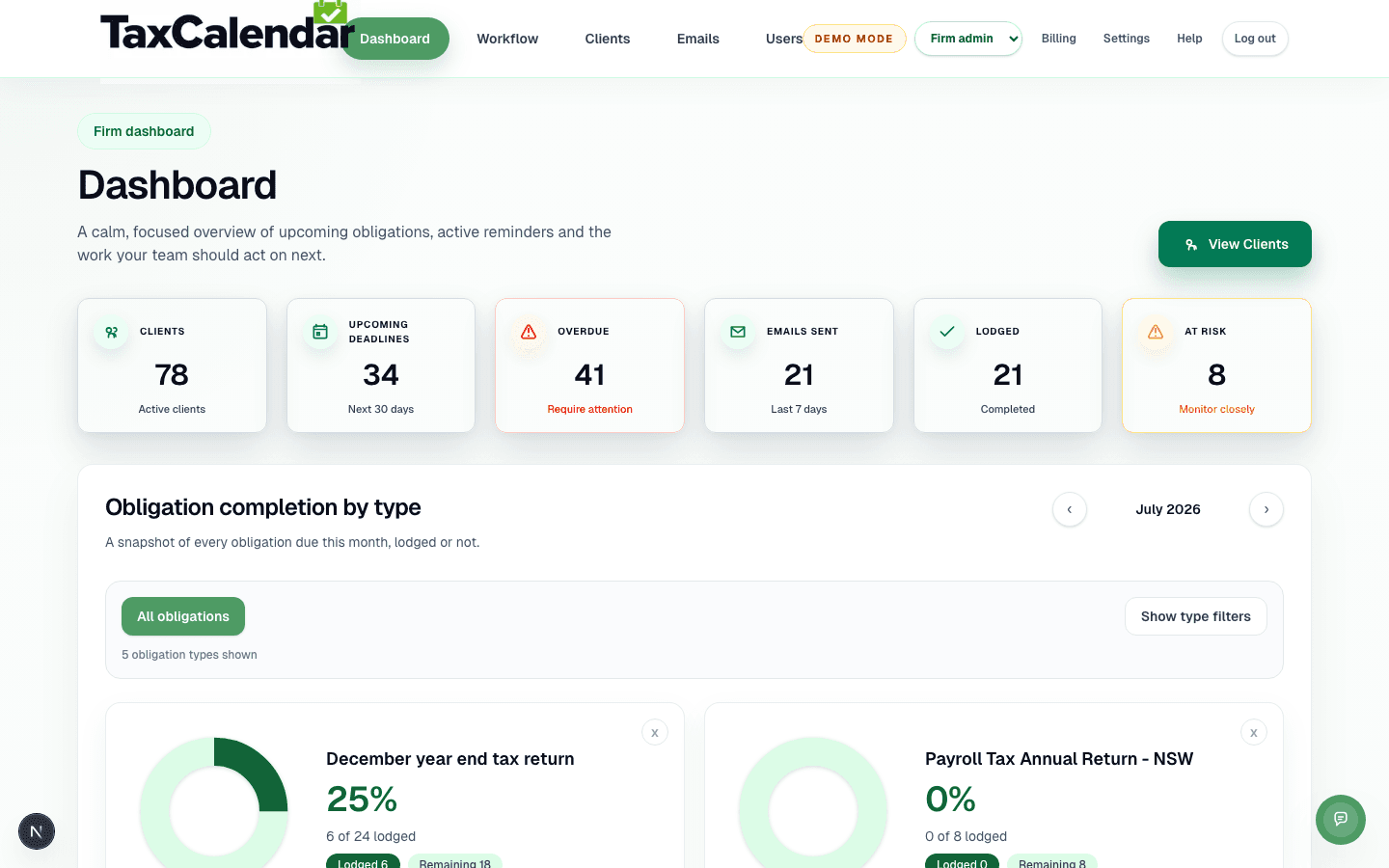
Overdue obligations dashboard
TaxCalendar's dashboard surfacing every ATO and ASIC obligation across a firm's client base, so nothing runs late long enough to start compounding interest.
Why the number keeps growing
Three structural changes explain the recent acceleration. GIC compounds daily and is set well above the cash rate, currently sitting between roughly 10.6% and 11.4% depending on the quarter, compared to under 8% a few years ago. A tax debt left unpaid compounds fast at that rate.
In late 2023 the ATO also moved to a stricter approach to remitting (forgiving) GIC than it had taken previously, without clearly communicating the shift, leaving many taxpayers and practitioners caught out by interest they expected to have waived.
And from 1 July 2025, GIC and SIC are no longer tax-deductible, meaning the effective cost of carrying ATO debt got meaningfully worse for every business and individual affected.
How ASIC late fees compare
ASIC's penalty regime works completely differently, and is far smaller in scale. Rather than daily compounding interest, ASIC charges flat, capped late fees: $102 if an annual review fee or lodgement is paid within one month of the due date, and $428 if it's paid more than one month late.
Because these are one-off flat fees rather than compounding interest on a debt balance, ASIC's total late-fee take, while not separately published, sits nowhere near the ATO's multi-billion-dollar GIC book. A company that misses an ASIC annual review by two months pays a fixed penalty in the hundreds of dollars; a company that misses an ATO payment by two months is exposed to daily-compounding interest on the full debt, which can run into the thousands or more depending on the amount owed.
What this means for accounting firms and their clients
The gap between the two regimes is the real takeaway: ATO non-compliance is financially dangerous in a way ASIC non-compliance simply isn't. A missed ASIC deadline is an annoying, fixed cost. A missed ATO deadline compounds daily and, since mid-2025, can no longer even be partly offset through a tax deduction.
For accounting firms managing dozens or hundreds of client entities across ATO and ASIC obligations, the cost of a missed deadline isn't hypothetical, it's a specific, calculable dollar figure that lands on the client's desk. Firms relying on spreadsheets or inbox reminders to track hundreds of ATO and ASIC dates across hundreds of entities are one missed date away from a client eating an avoidable interest bill.
For a public practice, the operational risk is rarely the date itself. The risk is that no-one owns the follow-up, the client reminder is sent too late, the manager cannot see what is stuck, or the team is using a spreadsheet that is no longer trusted. TaxCalendar is designed to connect due dates, client reminders, workflow ownership and compliance visibility in one place.
This is the exact problem TaxCalendar was built to solve: every entity a firm manages, company, trust, SMSF, individual, has a permanent compliance record with every ATO and ASIC obligation automatically tracked, so nothing falls through the cracks of a shared calendar or someone's inbox.
Recommended reminder and workflow cadence
A strong compliance process separates client communication from internal work allocation. Tax agents can use client reminders at 30, 14, 7, 2 and 0 days before the due date, while managers use earlier workflow dates to check whether records have arrived, preparation has started and review is on track.
This matters because lodgement deadlines are rarely missed for one dramatic reason. They are missed because small items stay hidden: a missing email address, an unassigned manager, a client who has not approved the work, or an obligation sitting in a spreadsheet that only one person trusts. TaxCalendar is built to make those issues visible before they become deadline pressure.
Where TaxCalendar fits
TaxCalendar helps Australian accounting firms turn compliance dates into a visible workflow. Firms can track clients, obligations, due dates, manager ownership, reminder status and lodged status in one place. That gives public practice teams a practical operating layer for BAS, IAS, ATO lodgement calendars, annual returns, client reminders and recurring practice management routines.
Related questions
How much interest does the ATO charge on unpaid tax debt?
The ATO's general interest charge (GIC) compounds daily and is set well above the cash rate, currently sitting between roughly 10.6% and 11.4% depending on the quarter.
Is ATO interest still tax-deductible?
No. From 1 July 2025, general interest charge (GIC) and shortfall interest charge (SIC) are no longer tax-deductible, increasing the effective cost of carrying ATO debt.
How much are ASIC late fees?
ASIC charges a flat late fee: $102 if a company annual review is paid within one month of the due date, and $428 if it's paid more than one month late. Check asic.gov.au for the current amounts, as they're indexed periodically.
Why has the amount of GIC owed to the ATO grown so much?
A 2026 Tax Ombudsman review found the total balance of GIC owed to the ATO grew 185% between 2019 and 2025, nearly double the growth in uncontested tax debt overall, driven by high compounding rates and a stricter remission stance the ATO adopted in late 2023.
Is a missed ATO deadline more costly than a missed ASIC deadline?
Generally yes. ASIC late fees are flat and capped, while ATO general interest charge compounds daily on the full debt and, since mid-2025, can no longer be offset through a tax deduction.
Sources
Facts and figures in this guide are drawn from the following official sources. Rates and thresholds are indexed periodically, so always confirm current amounts before quoting them to a client.