How Many Accountants and Clients Actually Miss Deadlines?
What the ATO's own lodgment performance benchmark reveals about how often tax agents and their clients miss deadlines, and why late lodgement is more common than most firms assume.
This guide is written for Accounting firm partners and managers wanting to benchmark their own lodgement performance. It explains how the obligation fits into Australian public practice, how firms can plan lodgement deadlines before they become urgent, and how client reminders, workflow ownership and practice management routines can reduce compliance risk.
Key dates and timing considerations
Due dates are only useful when the firm turns them into a working system. Australian accounting firms need to know the statutory or ATO lodgement deadline, but they also need earlier internal workflow dates for record collection, preparation, manager review, partner review, client approval and final lodgement.
- Registered tax agents get extended due dates for their clients through the ATO's lodgment program, in exchange for meeting the program's requirements.
- One of those requirements is lodging at least 85% of the agent's prior-year lodgment program obligations on time, a benchmark the ATO developed with the Lodgment Working Group and professional association representatives.
- That 85% benchmark implicitly accepts that some share of a registered agent's client lodgements will run late in a given year without it being treated as a failure of the agent.
- There's no equally precise public figure for how many individual clients miss a given deadline, but the fact the ATO built a tolerance into its own framework says the profession already treats some lateness as expected, not exceptional.
How to operationalise this inside an accounting firm
The most effective firms treat this topic as part of a wider compliance operating rhythm, not as an isolated date in a diary. A partner, director or manager should be able to open one view and see which clients are affected, which due dates are coming up, which reminders have been sent, which work is waiting on the client and which lodgements are at risk. That visibility is what turns a tax calendar into a practice management tool.
For public practice teams, the first step is to define ownership. Every client should have a responsible manager or staff member, and every recurring obligation should have a clear workflow path. That path normally includes information requested, information received, preparation started, manager review, partner review, client approval and lodged. Smaller firms may use fewer stages, but the principle is the same: the firm needs a shared language for progress.
Client communication
Client reminders should be specific, early and consistent. A useful reminder explains what the firm needs, when it is needed, what the client should do next and why the timing matters for ATO compliance or the relevant lodgement deadline.
Manager visibility
Managers need more than a list of dates. They need to know which clients have not responded, which jobs are unassigned, which obligations are approaching review and where workflow capacity is becoming tight across the team.
This is especially important when a firm is moving away from a spreadsheet. Spreadsheets can record due dates, but they rarely create reliable accountability. They do not automatically show whether a client reminder was sent, whether a manager changed, whether an email bounced, or whether a lodgement is still waiting for approval. A structured compliance workflow gives the team a better way to manage recurring deadlines without relying on memory or inbox archaeology.
The one number the ATO actually publishes: 85%
Most of what gets said about how many businesses miss deadlines is guesswork, because there's no single published survey that answers it directly. But the ATO does publish one directly relevant number: registered agents need to lodge at least 85% of their prior-year lodgment program obligations on time to stay in good standing under the program, a benchmark it developed in consultation with the Lodgment Working Group and professional association representatives, taking into account circumstances that cause late lodgment that aren't the agent's fault.
Read that the other way around, and it means the system the whole profession operates inside already assumes that up to roughly one in seven of an agent's client lodgements can run late in a year without it being treated as a compliance failure. That's not a loophole, it's a deliberate design choice, because the ATO knows some lateness is caused by client circumstances no agent can fully control.
Falling short of the benchmark doesn't mean an automatic penalty. The ATO generally reviews performance and works with the agent first, with loss of lodgment program access reserved for persistent or serious underperformance rather than a single soft quarter.
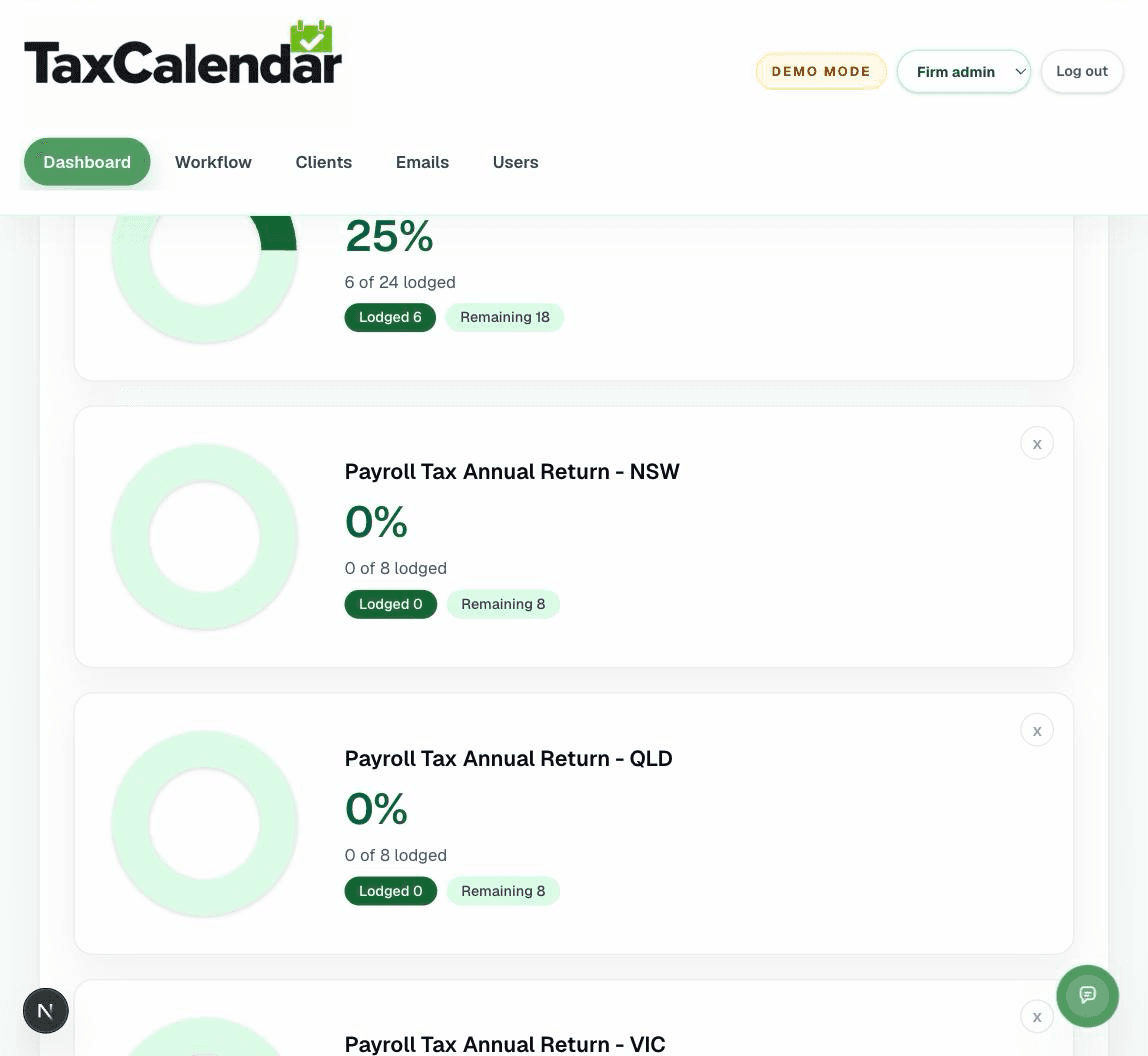
Firm-wide obligation view
Seeing every client's obligation status in one place makes it possible to know where a firm actually sits against its own on-time rate, rather than guessing.
Why deadlines get missed in practice
Behind that 15% tolerance are a handful of recurring, practical reasons. Client records arrive late more often than firms expect, and it commonly takes three or four follow-ups across emails and calls before a client actually reconciles their accounts and sends through what's needed. Firms with clients on different obligation types and cycles, BAS quarterly, IAS monthly, ASIC annually, are tracking dozens of overlapping due dates that don't line up neatly on a single calendar.
Add in that a lot of firms are still tracking all of this across a spreadsheet, a shared inbox and individual staff memory, and it becomes easy for one client's status to fall out of anyone's view until the due date has already passed. None of this is unique to any one firm, it's a fairly predictable outcome of the way compliance work is structured across a busy client base.
What persistent lateness signals for a firm
A single late lodgement here and there is within the tolerance the ATO itself designed for. What's worth paying attention to is a trend: the same clients running late every cycle, or a firm's overall on-time rate drifting toward that 15% ceiling without anyone noticing until performance is reviewed. That's usually a visibility problem rather than a client problem, the firm can't see what's at risk early enough to act on it, not that clients are unusually difficult.
Fixing that doesn't require chasing harder, it requires being able to see, at any point in the quarter, which obligations across the whole client base are on track, at risk or already overdue, instead of relying on one person's spreadsheet or memory to catch it in time.
Recommended reminder and workflow cadence
A strong compliance process separates client communication from internal work allocation. Tax agents can use client reminders at 30, 14, 7, 2 and 0 days before the due date, while managers use earlier workflow dates to check whether records have arrived, preparation has started and review is on track.
This matters because lodgement deadlines are rarely missed for one dramatic reason. They are missed because small items stay hidden: a missing email address, an unassigned manager, a client who has not approved the work, or an obligation sitting in a spreadsheet that only one person trusts. TaxCalendar is built to make those issues visible before they become deadline pressure.
Where TaxCalendar fits
TaxCalendar helps Australian accounting firms turn compliance dates into a visible workflow. Firms can track clients, obligations, due dates, manager ownership, reminder status and lodged status in one place. That gives public practice teams a practical operating layer for BAS, IAS, ATO lodgement calendars, annual returns, client reminders and recurring practice management routines.
Related questions
What is the ATO's 85% on-time lodgment requirement?
It's the benchmark registered tax agents need to meet, lodging at least 85% of their prior-year lodgment program obligations on time, to retain access to the extended due dates the lodgment program provides.
What happens if a tax agent falls below the 85% benchmark?
The ATO generally reviews the agent's performance and works with them first. Loss of lodgment program access is reserved for persistent or serious underperformance, not a single quarter below benchmark.
Is a firm doing something wrong if some lodgements run late?
Not necessarily. The ATO's own benchmark already assumes some share of lodgements across an agent's client base will run late in a given year. The thing worth watching is a trend toward or past that tolerance, not any single late lodgement.
How can a firm track its own on-time lodgment rate?
By tracking status, not just due dates, against every client obligation in one shared system, so managers and partners can see what's on track, at risk or overdue across the whole client base rather than reconstructing it manually at review time.
Sources
Facts and figures in this guide are drawn from the following official sources. Rates and thresholds are indexed periodically, so always confirm current amounts before quoting them to a client.