Why Proactive Communication (Not More Effort) Is What Actually Keeps Accounting Clients Happy
The data on client satisfaction, retention, and communication in accounting firms — and why the fix is usually a systems problem, not a people problem.
This guide is written for Accounting firm partners and managers wanting to improve client satisfaction and retention without adding headcount. It explains how the obligation fits into Australian public practice, how firms can plan lodgement deadlines before they become urgent, and how client reminders, workflow ownership and practice management routines can reduce compliance risk.
Key dates and timing considerations
Due dates are only useful when the firm turns them into a working system. Australian accounting firms need to know the statutory or ATO lodgement deadline, but they also need earlier internal workflow dates for record collection, preparation, manager review, partner review, client approval and final lodgement.
- Only 48% of accounting clients say they're fully satisfied with their current accountant; among the satisfied minority, 77% specifically cite the firm's use of technology as the reason.
- 87% of accounting professionals name client delays as their single biggest workflow disruptor.
- 85% of business clients say prompt responsiveness strongly affects their loyalty to a firm.
- One firm that introduced a quarterly client satisfaction pulse survey with active follow-up lifted its retention rate by 5% within 12 months.
How to operationalise this inside an accounting firm
The most effective firms treat this topic as part of a wider compliance operating rhythm, not as an isolated date in a diary. A partner, director or manager should be able to open one view and see which clients are affected, which due dates are coming up, which reminders have been sent, which work is waiting on the client and which lodgements are at risk. That visibility is what turns a tax calendar into a practice management tool.
For public practice teams, the first step is to define ownership. Every client should have a responsible manager or staff member, and every recurring obligation should have a clear workflow path. That path normally includes information requested, information received, preparation started, manager review, partner review, client approval and lodged. Smaller firms may use fewer stages, but the principle is the same: the firm needs a shared language for progress.
Client communication
Client reminders should be specific, early and consistent. A useful reminder explains what the firm needs, when it is needed, what the client should do next and why the timing matters for ATO compliance or the relevant lodgement deadline.
Manager visibility
Managers need more than a list of dates. They need to know which clients have not responded, which jobs are unassigned, which obligations are approaching review and where workflow capacity is becoming tight across the team.
This is especially important when a firm is moving away from a spreadsheet. Spreadsheets can record due dates, but they rarely create reliable accountability. They do not automatically show whether a client reminder was sent, whether a manager changed, whether an email bounced, or whether a lodgement is still waiting for approval. A structured compliance workflow gives the team a better way to manage recurring deadlines without relying on memory or inbox archaeology.
The gap between how firms and clients see the same problem
Most advice on client communication tells accountants to be more responsive, more personable, or more available. The data tells a more useful story: the firms winning on client satisfaction aren't working harder at communication, they've made contact automatic, so clients hear from them before they have to ask.
Only 48% of accounting clients say they're fully satisfied with their current accountant. But among the ones who are satisfied, the reason is telling: 77% specifically point to their accountant's use of technology as the reason.
There's a mismatch in how firms and clients experience the same friction. 87% of accounting professionals name client delays as their single biggest workflow disruptor — the unread emails, the late replies, the missing documents. But clients don't experience it that way at all. From their side, it looks like disorganisation: a pile of emails, unclear instructions about what's needed and when, and a different login for every interaction. The same friction reads as "the client is slow" internally and "the firm feels chaotic" externally.
What actually moves retention and loyalty
The evidence for proactive, systematic contact — not more charm, just more consistency — is strong. 85% of business clients say prompt responsiveness strongly affects their loyalty to a firm.
One firm that introduced a quarterly client satisfaction pulse survey with active follow-up lifted its client retention rate by 5% within 12 months, not through better service delivery, just through more regular, structured contact.
McKinsey's broader research across industries found companies that proactively improved customer experience through communication roughly doubled their revenue growth compared to competitors over a five-year period. A repeat customer is also 67% more likely to spend with a business than a new one, meaning retained clients aren't just cheaper to keep, they're worth more.
The real problem isn't a skills gap
Most firms respond to this data by trying to train staff to communicate better, or by hiring a dedicated client experience role. That treats the problem as a soft skill. It usually isn't.
The 87% of firms citing client delays as their top disruptor aren't lacking charm — they're lacking a system that pushes information out automatically. When reminders, deadlines, and status updates depend on someone remembering to send an email, communication becomes reactive by default: clients hear from the firm when something is overdue, not before. That's the exact moment a client starts to feel neglected rather than looked after, even if the underlying work is being done well.
What this means in practice
The fix isn't more effort from your team. It's moving reminders and status updates out of memory and email threads and into a system that sends them automatically, on schedule, every time, so clients get advance notice as a matter of course, not as an exception when someone happens to be on top of it that week.
For a public practice, the operational risk is rarely the date itself. The risk is that no-one owns the follow-up, the client reminder is sent too late, the manager cannot see what is stuck, or the team is using a spreadsheet that is no longer trusted. TaxCalendar is designed to connect due dates, client reminders, workflow ownership and compliance visibility in one place.
This is the client-facing side of what TaxCalendar already does on the compliance side. Every entity's obligations are tracked with automatic reminders firing ahead of deadlines, which means clients experience a firm that reaches out before they have to ask, without any extra work from your team. The retention and satisfaction upside isn't a separate initiative, it's a byproduct of compliance tracking done properly.
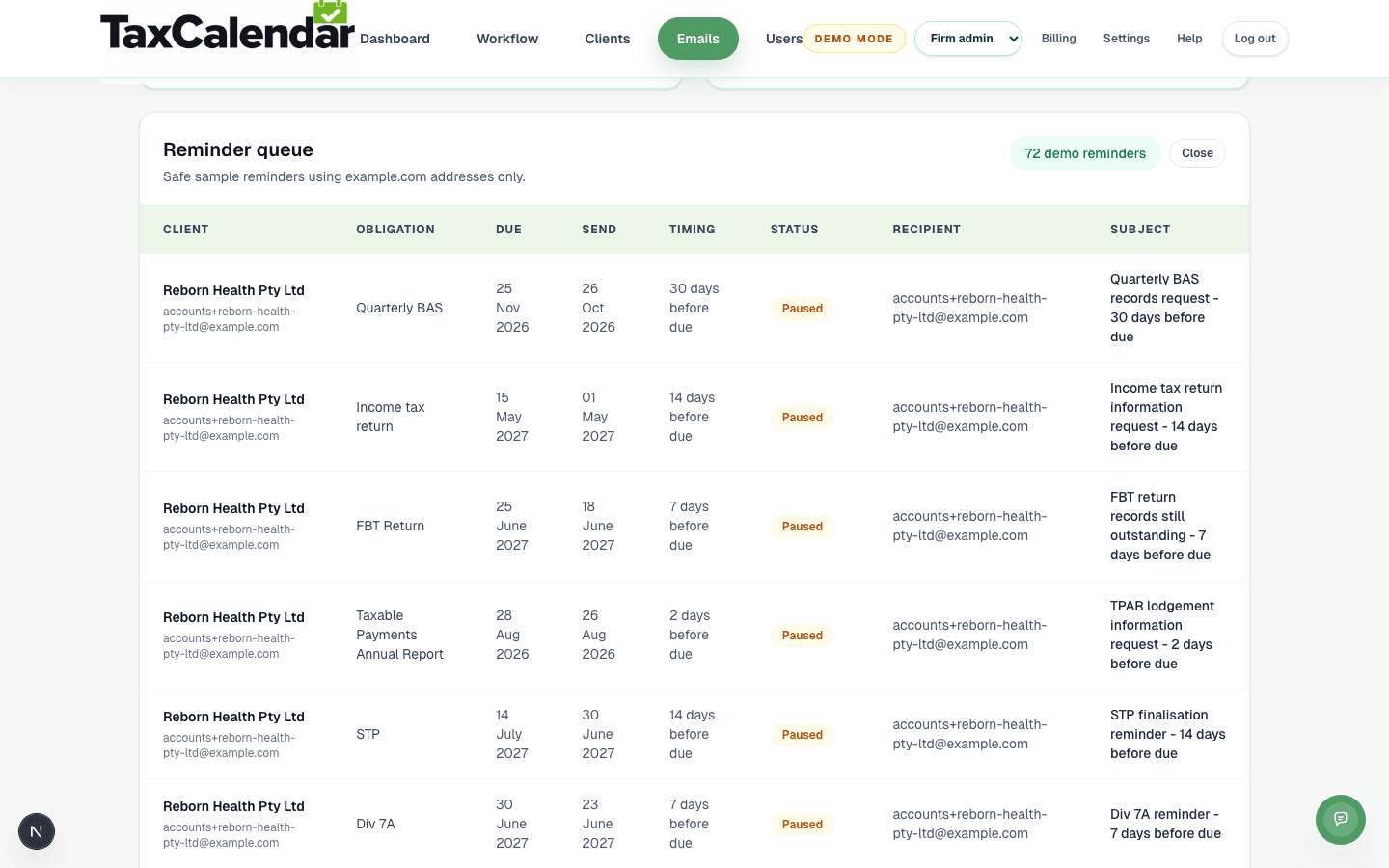
Automated client reminders
TaxCalendar's reminder queue sends status updates and deadline reminders to clients automatically, ahead of time, without depending on someone remembering to send the email.
Recommended reminder and workflow cadence
A strong compliance process separates client communication from internal work allocation. Tax agents can use client reminders at 30, 14, 7, 2 and 0 days before the due date, while managers use earlier workflow dates to check whether records have arrived, preparation has started and review is on track.
This matters because lodgement deadlines are rarely missed for one dramatic reason. They are missed because small items stay hidden: a missing email address, an unassigned manager, a client who has not approved the work, or an obligation sitting in a spreadsheet that only one person trusts. TaxCalendar is built to make those issues visible before they become deadline pressure.
Where TaxCalendar fits
TaxCalendar helps Australian accounting firms turn compliance dates into a visible workflow. Firms can track clients, obligations, due dates, manager ownership, reminder status and lodged status in one place. That gives public practice teams a practical operating layer for BAS, IAS, ATO lodgement calendars, annual returns, client reminders and recurring practice management routines.
Related questions
What percentage of accounting clients are satisfied with their accountant?
Only around 48% of accounting clients report being fully satisfied with their current accountant. Among the satisfied minority, 77% specifically credit the firm's use of technology.
Does responsiveness really affect client loyalty at accounting firms?
Yes. 85% of business clients say prompt responsiveness strongly affects their loyalty to a firm, making it one of the clearest levers for retention available to a practice.
Can better client communication be achieved without hiring more staff?
Yes. The evidence points to structured, automatic contact, not more staff time, as the driver: firms that move reminders and updates into a system that sends them on schedule see the retention benefit without adding headcount.
What's the difference between reactive and proactive client communication?
Reactive communication happens after something is already overdue, when the client has to chase the firm. Proactive communication reaches the client ahead of a deadline or milestone automatically, before they've had to ask.
Why does a quarterly satisfaction survey improve retention?
Not because of the survey questions themselves, but because it creates a structured, recurring point of contact with active follow-up — one firm that introduced this lifted its retention rate by 5% within 12 months.
Sources
Facts and figures in this guide are drawn from the following official sources. Rates and thresholds are indexed periodically, so always confirm current amounts before quoting them to a client.
- TaxDome: 65+ Accounting Statistics and Insights
- ClearlyRated: Satisfaction Survey Checklist for Accounting Firms
- AccountingWEB: Why Client Communication Is Still the Biggest Challenge for Accounting Firms
- Association for Accounting Marketing: Why Every Accounting Firm Needs a Client Experience Strategy
- Uku: Client Communication Best Practices for Accounting Firms